

Labeling, data and models
in one platform.
Label images, videos, 3D point clouds, medical volumes, meshes and audio, curate datasets, and train, evaluate and deploy computer vision models, in our cloud or on your own servers.


Labeling interfaces for six types of data.
Images, videos, 3D point clouds and medical volumes each have a labeling toolbox of their own, and so do meshes and audio. In every one of them, AI assistants and your own models take the first pass.
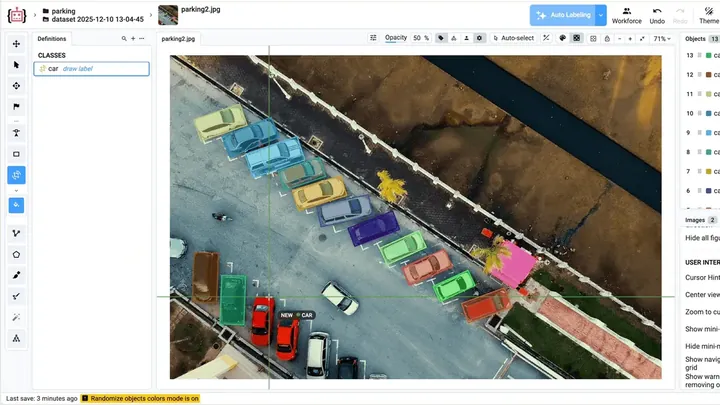
Image labeling
Boxes, polygons, brushes and keypoints, with AI assistants for pixel-accurate masks, on photos and on multispectral, multi-view and very large images.
Video labeling
AI tracking follows objects through long videos, with synchronized multi-camera views and GPS telemetry on a map.
3D point clouds
LiDAR and RADAR point clouds and episodes, with cuboids, segmentation and AI tracking next to synchronized camera images.
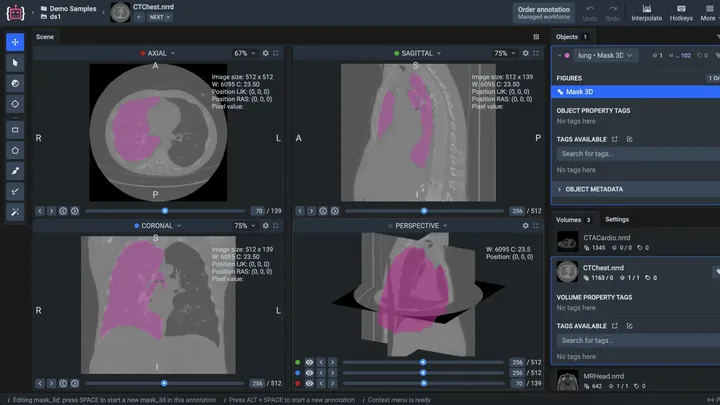
Medical imaging
CT and MRI volumes from DICOM, NRRD or NIfTI in axial, sagittal, coronal and 3D views, with 3D interpolation between labeled slices.
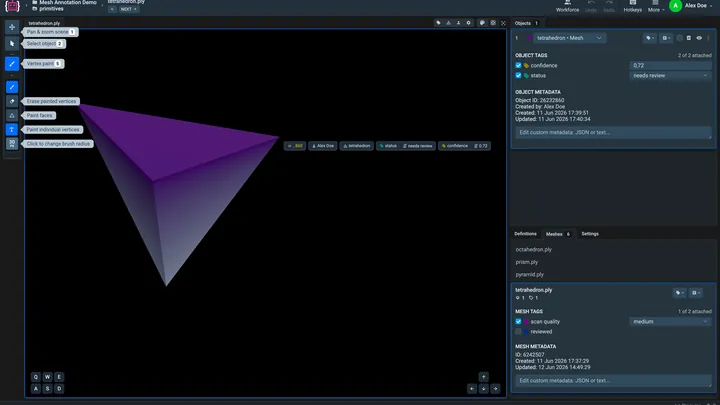
3D meshes
Paint the vertices and faces of PLY, STL and OBJ meshes to label surface regions, and tag every mesh and object.
Audio
Label WAV, FLAC, MP3, OGG and M4A recordings on the waveform and spectrogram, as timed events or tags on the whole recording.
Curate the data and run the labeling.
Find what is worth labeling, let models take the first pass, and run labeling teams with review and consensus built in.
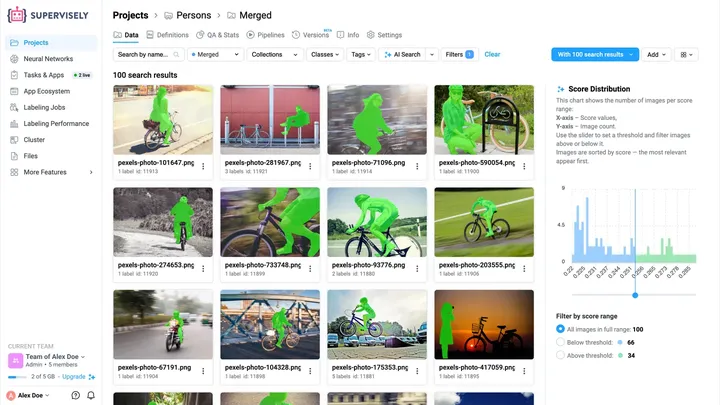
Data curation
Find what is worth labeling with AI Search and filters, version every dataset, and convert, split and augment data in pipelines instead of scripts.
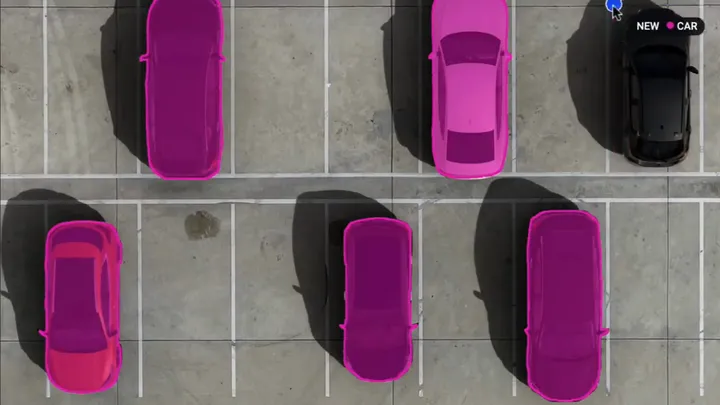
AI-assisted labeling
Models take the first pass: AI assistants turn a few clicks into a precise mask, your models pre-label whole projects, and Live Training learns while you label.
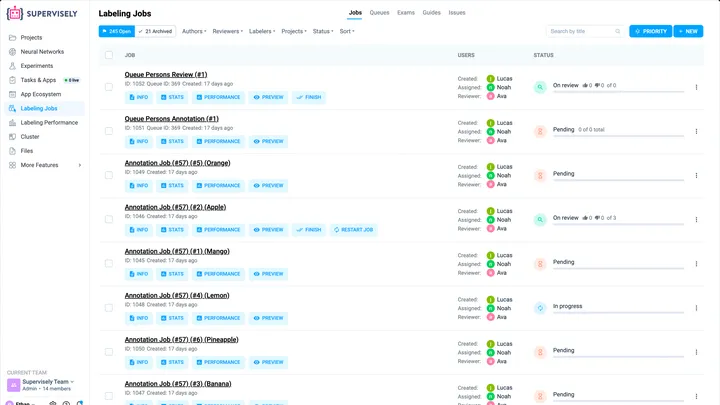
Labeling workflow
Split the work into labeling tasks, send items to several annotators for consensus, review every label and see the speed and acceptance rate of each annotator.
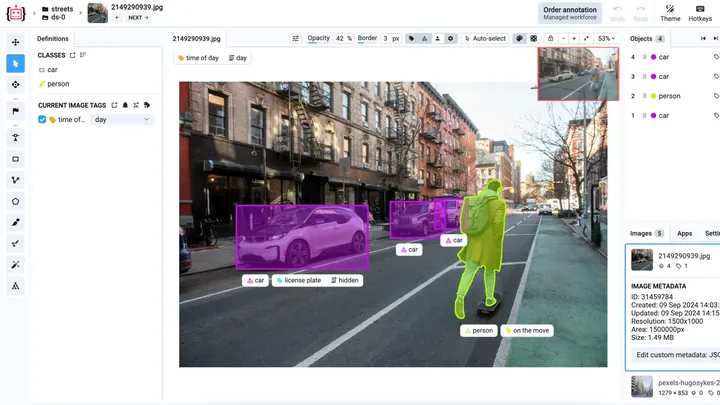
Custom labeling UI
When no standard toolbox fits a task, add tools of your own to the labeling editor, written in Python.
Train, evaluate and deploy models on your data.
Training and evaluation run next to the labeled data, with no export step in between, and the trained model pre-labels the next batch.
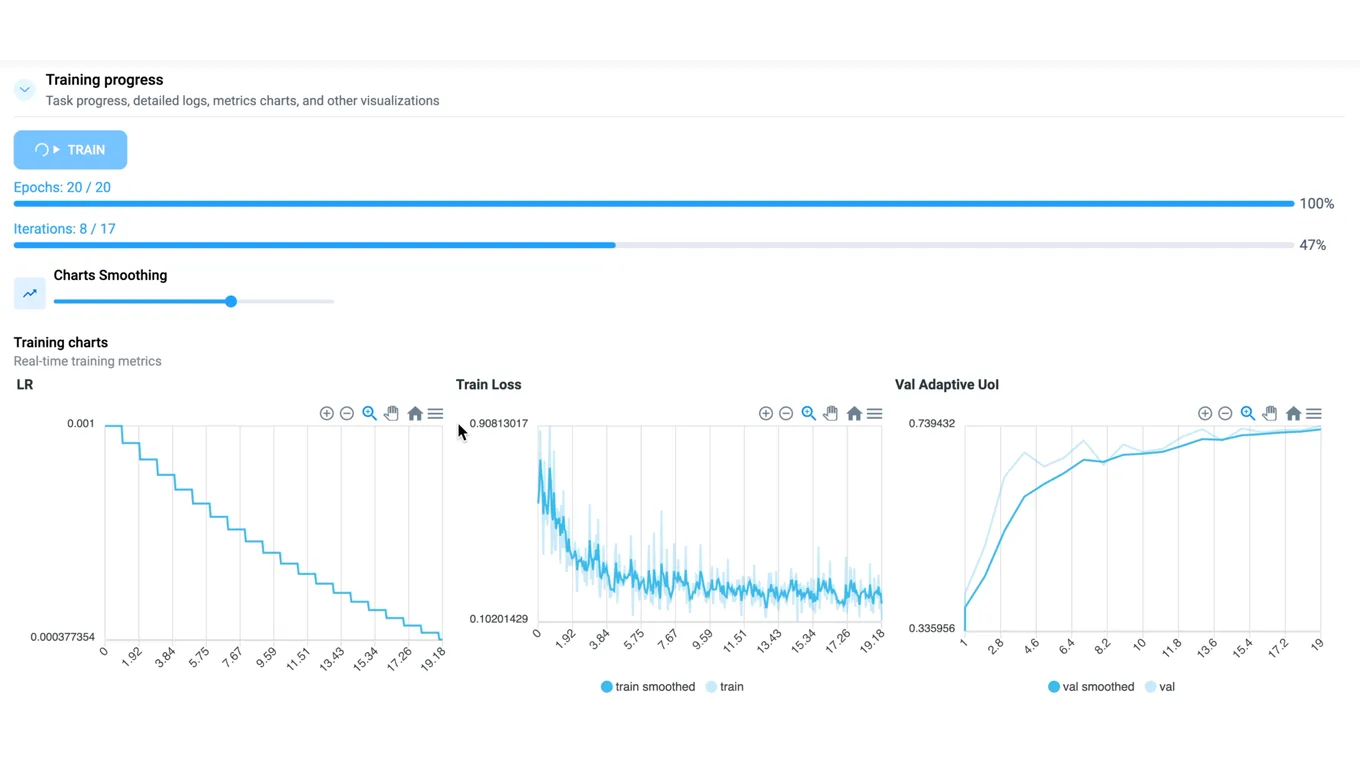
Model training
Train YOLO26, DEIMv2 or RT-DETRv2 on your labeled data without code, track every run in one table, and deploy models on your own GPUs.
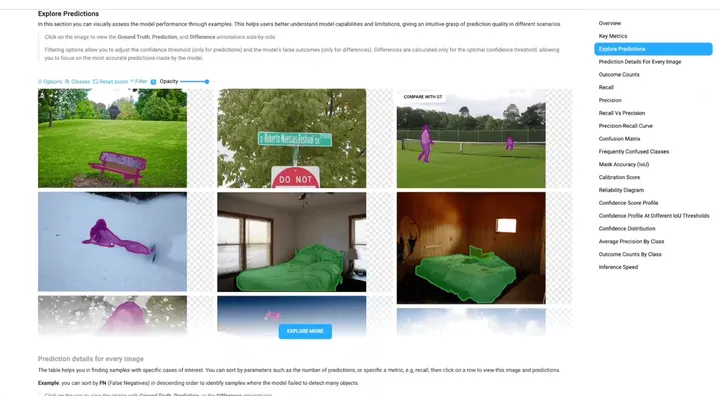
Model evaluation
Every trained model gets an evaluation report with mAP, precision and recall, and a click on any error opens the images behind it.
How the parts fit together.
A project moves through the platform in six steps, and the last one starts the next round of labeling.
- 01
Import and curate
Bring data from your cloud storage or in COCO, YOLO and other formats, and find what is worth labeling with AI Search.
Data curation - 02
Label
Labeling tasks split the work between annotators, and AI assistants take the first pass in every toolbox.
AI-assisted labelingLabeling workflow - 03
Review
Reviewers check every label, consensus shows where annotators disagree, and each annotator’s speed and acceptance rate are on record.
Labeling workflow - 04
Train
Train a model on the labeled data without code, on GPUs you connect, and compare runs in one table.
Model training - 05
Evaluate
Every trained model gets an evaluation report, and every error in it leads to the images behind it.
Model evaluation - 06
Pre-label the next batch
The new model labels fresh data, so the next round starts from its predictions instead of empty images.
AI-assisted labelingModel trainingThen back to step 2
Runs in our cloud or on your servers.
Start free in the cloud, move to your own servers with Enterprise, and connect Supervisely to the rest of your stack through the SDK and the API.
Enterprise Edition
Supervisely on your own servers, in a private cloud or a Kubernetes cluster, or fully offline, with single sign-on and custom roles.
Supervisely EnterpriseSecurity
Self-hosted and air-gapped deployment, single sign-on, roles in every team and an activity log of every action.
Security at SuperviselyEcosystem
400+ apps for import and export, neural networks and data tools, an open-source Python SDK and a REST API.
Explore the EcosystemPricing
Community is free with 2 members, 5 GB of storage and 10,000 files. Pro starts at €199 per month, and Enterprise is custom-priced.
Compare plans
Here’s why teams trust us.
“A very high product quality.”
BMW Group uses Supervisely to annotate manufacturing images from production lines in their world-wide plants for enhancing quality inspections using deep learning. Supervisely is integrated into the BMW Group AI Platform in order to empower computer vision based AI use cases.
 BMW Group · Manufacturing quality inspection
“Immensely grateful for their pivotal role in our work”
Working with Supervisely has significantly enhanced our capability to develop AI models for lung CT scans. What sets Supervisely apart is its exceptional support team who are really responsive and adapt to our unique needs with a range of apps and helper files.

“Helps us to do data scientist work better and faster”
We use Supervisely since 2019. The key advantage of this tool is that Supervisely provides a complete data treatment pipeline. An important advantage is that a Supervisely instance can be deployed autonomously on a Client infrastructure, and distributed on different servers.

“A valuable part of our computer vision operations”
Supervisely is a valuable part of our computer vision operations, enabling our teams to efficiently work with camera and LiDAR data across sensor fusion projects. We use Supervisely for its extensive feature set and its ability to adapt to our changing requirements.

“Extremely satisfied with Supervisely and would highly recommend it”
The review tools have been invaluable in ensuring the quality and accuracy. The Python SDK has also been incredibly helpful in automating and streamlining our workflow. The support team on Slack has been extremely helpful and responsive.

“Supervisely excels at that and much more”
We’ve been exceedingly impressed with the customer support, addition of new features, and the flexibility of the publicly available SDK/API. The Supervisely team has also been fast to respond to support questions, and has shown a lot of openness when given feedback on potential improvements.

Your team next?
Talk to a computer vision engineer about your data, your models and your infrastructure.
Book a demoFrequently asked questions.
Which data types can I label in Supervisely?
Images, including multispectral and multi-view ones, videos, LiDAR and RADAR point clouds and episodes, and DICOM, NRRD or NIfTI volumes each have a labeling toolbox: see image labeling, video labeling, 3D point clouds and medical imaging. The mesh labeling toolbox labels surface regions on PLY, STL and OBJ meshes, and audio projects label WAV, FLAC, MP3, OGG and M4A recordings on the waveform and spectrogram.
Can I run Supervisely on my own servers?
Yes, with the Enterprise Edition. It runs on your own servers, in a private cloud or in a Kubernetes cluster, or fully offline in a network without internet access, so your data stays in your environment. See security.
Is there a free plan?
Yes. Community is free for individuals, researchers and small teams and needs no credit card: 2 members, 5 GB of storage and 10,000 files. Pro starts at €199 per month with 3 members included, and Enterprise is priced by the modules and users you need. Compare the plans.
Which models can I train in Supervisely?
YOLO from YOLOv8 to YOLO26 for detection, segmentation and pose estimation, DEIMv2 and RT-DETRv2 for real-time detection, MMDetection 3.0, and fine-tuning of Segment Anything. Training runs on GPU machines you connect. See model training and deployment.
Do I need to write code?
No. Labeling, data curation, training, deployment and evaluation all work without code. Code is optional: the open-source Python SDK and the REST API automate the platform and connect it to your own software. Start at the developer portal.